5 Social Media Trends Businesses Should Watch in 2026!
- marketbenchers
- June 25, 2026
- Social Media
- 0 Comments
Social media continues to reshape the way businesses communicate, market, and grow. What started as a brand awareness channel has evolved into a complete ecosystem for customer engagement, commerce, trust-building, and business development.
As we move through 2026, businesses are facing a different digital environment than they did even a few years ago. Audiences are more selective, competition is more intense, and platforms are prioritizing meaningful interactions over broad reach.
Consumers now expect personalized experiences, authentic communication, and content that delivers immediate value.
For brands, adapting to these shifts is no longer optional; it’s becoming a requirement for staying visible and competitive.
The good news is that businesses do not need to chase every new platform or trend. Instead, they need to understand where consumer behavior is heading and build strategies around those changes.
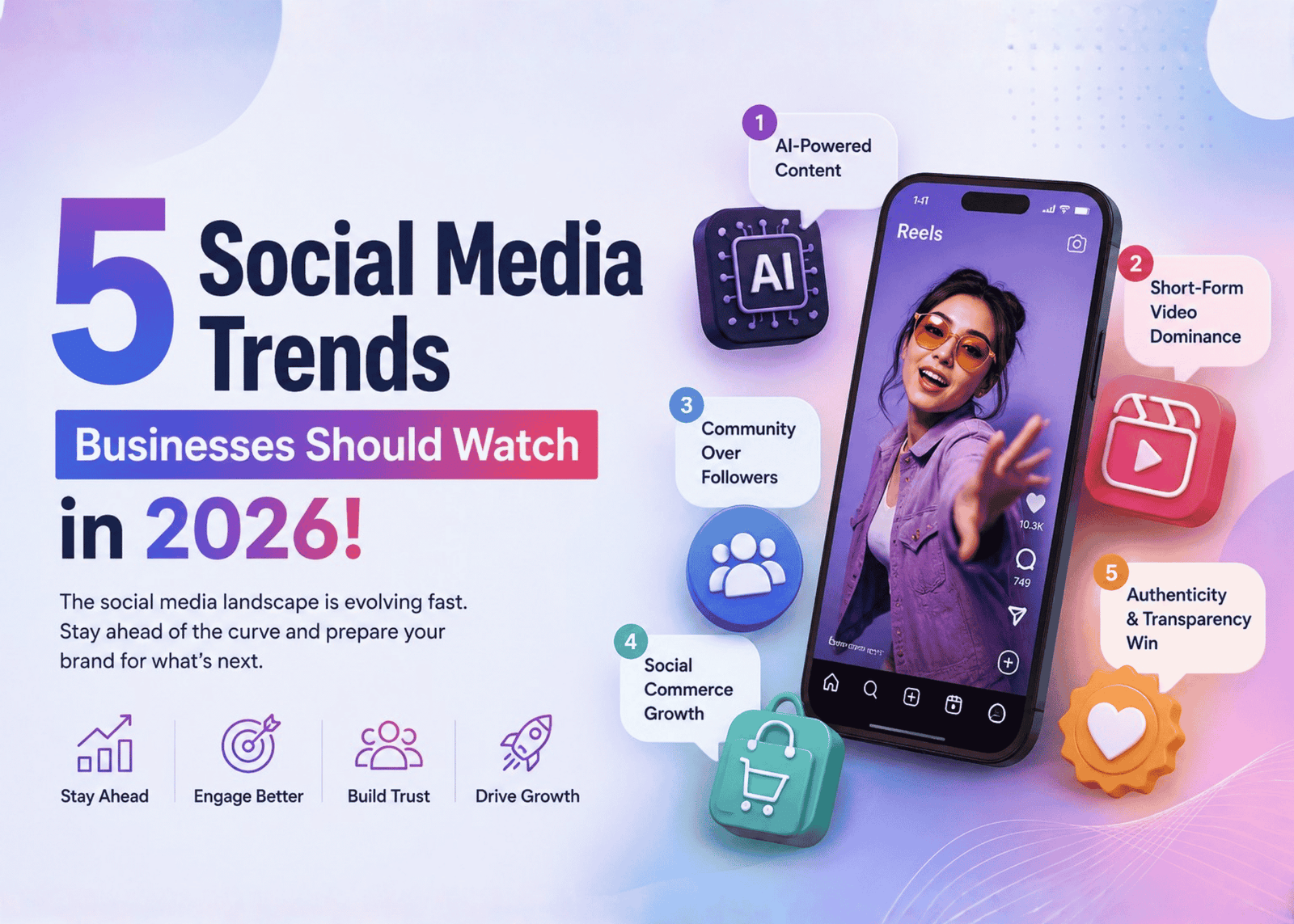
Here are five social media trends businesses should watch in 2026 and practical ways to turn them into measurable growth opportunities.
1. AI-Powered Content Will Become the New Standard
Artificial intelligence has transformed social media from a manual publishing process into a data-driven growth engine.
In 2026, businesses are using AI not simply to produce more content but to create better content—faster, smarter, and more relevant to audience needs.
AI tools now support nearly every stage of the content lifecycle, including research, content ideation, copy creation, design assistance, scheduling, audience analysis, and performance optimization.
However, the businesses seeing the strongest results are not replacing people with AI—they are combining technology with human creativity.
Consumers can quickly recognize generic or overly automated messaging. This means successful brands are focusing on maintaining originality while using AI to improve efficiency.
Why this trend matters:
- Content demand continues to increase across platforms
- Personalized experiences drive stronger engagement
- Faster production allows teams to remain competitive
- Data-driven decisions improve campaign performance
Practical applications for businesses:
- Generate multiple campaign concepts quickly
- Personalize messaging for audience segments
- Create platform-specific content variations
- Use analytics to optimize publishing schedules
Best Practice:
Treat AI as an assistant—not your brand voice. Use it to accelerate execution while ensuring every piece of content reflects your company’s identity and values.
2. Short-Form Video Will Continue Dominating Engagement
If there is one format that continues to outperform across industries, it is short-form video.
People consume content differently today. They want information quickly, visually, and in a format that fits into daily routines.
Short-form video has become one of the most effective ways to educate audiences, increase visibility, and encourage interaction.
But businesses often misunderstand why this format succeeds.
It is not because videos are short—it is because they are easy to consume and immediately valuable.
Brands that focus on storytelling, usefulness, and consistency tend to outperform those investing heavily in production quality alone.
Types of short-form content performing well:
- Educational tips and insights
- Product demonstrations
- Behind-the-scenes content
- Customer success stories
- Industry commentary
- Team introductions
Why businesses should prioritize video:
- Increases content discoverability
- Encourages higher engagement rates
- Improves audience retention
- Builds stronger emotional connection
Content Repurposing Strategy:
One blog article can become:
- Multiple short videos
- Carousel posts
- Quick educational clips
- Story updates
- Community discussions
Best Practice:
Focus on solving one problem or delivering one insight per video rather than trying to communicate everything at once.
3. Community-Led Marketing Will Outperform Traditional Reach
For years, brands focused heavily on follower counts and impressions.
In 2026, businesses are shifting attention toward something more valuable—community.
Communities create stronger relationships because they encourage participation rather than passive consumption.
Customers increasingly trust recommendations, conversations, and shared experiences more than polished advertising campaigns.
That is why successful businesses are building spaces where audiences interact directly with the brand and with each other.
Community-led growth is becoming one of the strongest competitive advantages.
Characteristics of community-first brands:
- Consistent audience interaction
- User-generated content
- Collaborative conversations
- Customer recognition initiatives
- Transparent communication
Ways businesses can strengthen communities:
- Host live discussions
- Encourage audience contributions
- Run polls and interactive sessions
- Highlight customer stories
- Respond actively to comments
Business impact:
Communities often lead to:
- Higher customer retention
- Increased loyalty
- More referrals
- Better feedback loops
Best Practice:
Measure community health through engagement quality and recurring participation—not follower growth alone.
4. Social Commerce Will Become a Core Revenue Channel
The line between social media and online shopping continues to disappear.
Social commerce is transforming platforms into spaces where customers discover, evaluate, and purchase products within a single experience.
Consumers increasingly expect convenience. They want fewer steps between inspiration and action.
Businesses that simplify purchasing journeys are likely to capture more opportunities.
Social commerce also changes how brands think about content.
Instead of separating marketing and sales efforts, businesses are creating content that naturally moves users toward conversion.
What social commerce looks like in 2026:
- Product discovery through social feeds
- Creator-led recommendations
- Interactive shopping experiences
- Integrated checkout experiences
- Real-time product demonstrations
How businesses can prepare:
- Optimize social profiles for conversion
- Create educational product content
- Use authentic customer testimonials
- Reduce purchase friction
Important shift:
Consumers increasingly purchase based on trust signals such as reviews, demonstrations, and community recommendations.
Best Practice:
Every social post should answer one question:
“What action should users take next?”
5. Authenticity and Employee Advocacy Will Build More Trust
Trust has become one of the most valuable assets in digital marketing.
Modern audiences are highly aware of overly polished marketing messages and increasingly prefer brands that communicate with transparency and personality.
This shift is creating new opportunities for employee advocacy.
People connect with people.
Employees, founders, and internal experts often generate stronger engagement than corporate brand pages because they feel more relatable and credible.
Businesses that encourage employees to contribute insights and experiences are building stronger digital trust.
Effective employee advocacy strategies:
- Share leadership perspectives
- Highlight employee expertise
- Encourage team storytelling
- Showcase workplace culture
- Create educational content from internal experts
Why authenticity matters:
Authentic content can:
- Improve credibility
- Increase audience trust
- Build stronger emotional connection
- Strengthen brand reputation
Best Practice:
Encourage real conversations instead of highly scripted messaging.
Final Thoughts
Social media in 2026 is evolving beyond content volume—it’s becoming smarter, more interactive, and centered around customer experience. Brands that stand out won’t be the ones posting the most, but the ones creating real and meaningful connections.
AI will help businesses work faster and deliver more personalized experiences. Short-form video will continue to boost visibility, while communities will play a bigger role in building loyalty. At the same time, social commerce will make the path from discovery to purchase faster than ever.
The key is not to follow every trend, but to adopt the right ones strategically—test, measure, and scale what delivers results.
The future of social media belongs to brands that balance innovation with authentic human connection.
Instead of chasing every new idea, choose one meaningful trend, stay consistent, and let small actions build long-term momentum.
Related Posts

- marketbenchers
- July 16, 2026
How Small Businesses Can Generate Consistent Leads Without Increasing Ad Spend
Generating consistent leads doesn't always require a bigger advertising budget. Discover practi ..
- marketbenchers
- September 3, 2024
Social Media Marketing for Small Businesses: Tips for Success!
Social media is no longer just about posting content—it’s about building trust, attracting ..